This is one of the most common, and frustrating, experiences for growing apparel brands. The sample fits. It looks right. It’s approved. Everyone moves forward with confidence. Then production arrives, and something is off.
The fit is tighter. Or looser. The proportions feel slightly different. Maybe the garment twists, shrinks, or doesn’t sit the same on the body. And the question becomes: how did we get here if the sample was approved?
The answer is almost never a single mistake. It’s a disconnect, between how a garment is validated in sampling and how it actually behaves in production. Understanding that gap is what allows brands to close it.
Sampling and Production Are Not the Same Environment
The first thing to understand is that a sample room and a production floor are fundamentally different environments.
In a sample room, garments are typically constructed by highly skilled technicians. There’s time to adjust, refine, and compensate during sewing. If something is slightly off in the pattern, it can often be corrected in the moment, sometimes without anyone explicitly documenting it.
The goal in sampling is to achieve the intended look and fit.
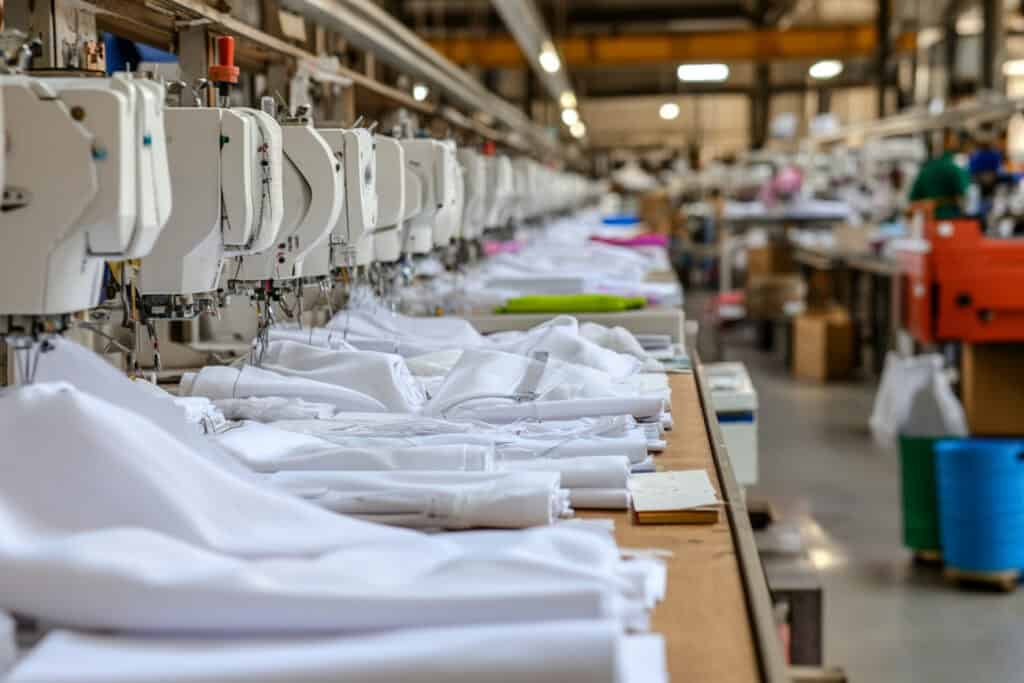
Production operates differently. It’s a system built on repetition. Multiple operators are executing specific steps, often under tight timelines. There is far less room for interpretation or adjustment. The expectation is that the pattern and documentation already contain everything needed to produce the garment consistently.
If the pattern relies on subtle refinements made during sampling, and those updates are not communicated back to the patternmaker, they will not be incorporated into production. The result is a garment that technically follows the pattern, but differs from the approved sample.
The Impact of Wash and Dye Processes
One of the most overlooked factors in fit discrepancies is what happens to the garment after it’s sewn.
Wash and dye processes can significantly alter how a garment behaves. Fabrics shrink. They soften. They distort slightly depending on how they’re treated. These changes are not always linear or predictable unless they are tested and accounted for in development.
This becomes especially important in categories like denim or garment-dyed products.
During development, teams work diligently to establish wash standards that will behave as predictably as possible in production. However, wash processes are inherently variable. Even small differences in temperature, agitation, chemical treatment, or machine load can affect shrinkage and final fit. Throughout sampling, shrink blankets are often evaluated with each wash iteration, and minor variations in shrinkage are common from sample to sample. Those same variables carry into production, where fabric rolls may also behave slightly differently from one another. In some denim workflows, each fabric roll is individually tested and shrink percentages are adjusted at the pattern level accordingly. If these variables are not accounted for through shrinkage allowances, wash engineering, and pattern adjustments, the production garment may not fully match the approved sample.
The sample wasn’t wrong—it simply reflected one controlled outcome within a process that still contains natural production variability.
Pattern, Process, and Material Are Interconnected
Fit is not controlled by the pattern alone. It is the result of three variables working together: the pattern, the process, and the material. The pattern defines shape and proportion. The process defines how that shape is constructed and finished. The material determines how the garment behaves under tension, movement, washing, and wear.
When a sample fits correctly, it means those three variables are aligned in that moment. In production, if even one of those variables shifts, the outcome changes.
For example, a fabric substitution, even one that appears similar, can alter stretch, recovery, drape, or shrinkage. A different sewing method can affect how seams sit or how tension is distributed throughout the garment. Wash processes can also influence final dimensions and fit after construction.
This is why sampling with production-intended materials from the beginning is so important. The sampling process is not simply about approving appearance—it is where problems are identified and corrected. A fabric may not support the intended silhouette properly. A construction detail may fail to perform as expected. Tension, recovery, or wash behavior may reveal issues that were not visible on paper.
It is also why we recommend beginning development in the same factory that will ultimately produce the garment whenever possible. Sampling allows the factory to learn the product early, refine execution standards, and resolve process inconsistencies before production begins. The goal is not simply to achieve one successful sample, but to build a repeatable system capable of producing consistent results at scale.
Without accounting for these variables holistically, consistency becomes difficult to maintain.
When “Approved” Doesn’t Mean “Finalized”
Another key factor is how sample approval is interpreted.
Approving a sample confirms that the design direction works. It does not necessarily mean that every technical element has been finalized for production.
There is often a gap between a garment that looks correct and one that is fully prepared for manufacturing at scale. That gap can include:
- Patterns that have not been fully trued or balanced
- Construction details that are not clearly documented
- Grading that has not been validated across sizes
- Shrinkage or wash behavior that has not been fully tested
When garments move into production with these elements unresolved, the result is variability. This is why an approved sample should be viewed as a checkpoint, not a finish line.
Why Issues Only Show Up in Production
Production exposes what sampling can hide. In a single sample, small inconsistencies may not be noticeable. In production, those inconsistencies are repeated across dozens, hundreds, or thousands of units.
This repetition amplifies even minor issues. A seam that was slightly eased in sampling becomes a consistent misalignment. A pattern that relied on manual adjustment produces uneven results. A fabric that shrinks unpredictably creates variation across sizes. What seemed like a small detail becomes a systemic problem.
This is especially true in grading. A base size may fit beautifully, while issues within the grading logic remain hidden until the garment is evaluated across the full size range. As sizes move further from the base, inconsistencies in proportion, balance, or POM relationships become more apparent. What appeared successful in one sample can begin to break down at the outer ends of the size range when the grading system itself is not performing correctly.
Bridging the Gap Between Sample and Production
Closing the gap between sample fit and production consistency requires intentional preparation.
Patterns need to be developed with production in mind, not just sample approval. That means validating balance, confirming seam relationships, and ensuring the pattern performs without relying on adjustments during sewing.
Construction intent must be clearly defined so that factories are not left to interpret how a garment should be assembled. Materials and processes must be tested under production conditions, especially when wash or dye treatments are involved.
And documentation needs to align all of these elements so that every team, from development to factory floor, is working from the same understanding. At XYZ Pattern Services, this is where the focus lies. Not just on creating a garment that looks right once, but on ensuring it performs consistently at scale.
From Sample Approval to Production Confidence
The goal of development is not simply to approve a sample. It’s to create a garment that can be reproduced reliably. When patterns, processes, and materials are aligned, and when validation happens before production instead of during it, brands gain predictability. Samples reflect reality. Production follows the same logic. Fit remains consistent. And the question of “why doesn’t this fit anymore?” doesn’t need to be asked. Because the answer was built into the process from the beginning.
Ready to Move Forward With Confidence?
XYZ Pattern Services is a professional patternmaking and apparel development studio supporting brands at every stage of growth. From production-ready patterns and fit standards to fully integrated development support, we act as an extension of your internal team, bringing clarity, accuracy, and accountability to every step of the process.
If you’re looking for a partner who understands both creative intent and manufacturing reality, we’d love to connect. Call us at 213-224-1577 or send us a message using the form below.
Strong patterns create efficient development, cleaner production, and brands that scale with confidence. We’re here to help you build it right.